Horizontal Machining Centers: Buyer Questions
Understand multi-face access, pallet systems and the full production cell
An HMC orients its spindle horizontally and often combines indexing with palletized work. Its business case is built from the total process: machining, loading, fixturing, chip control and noncutting time.
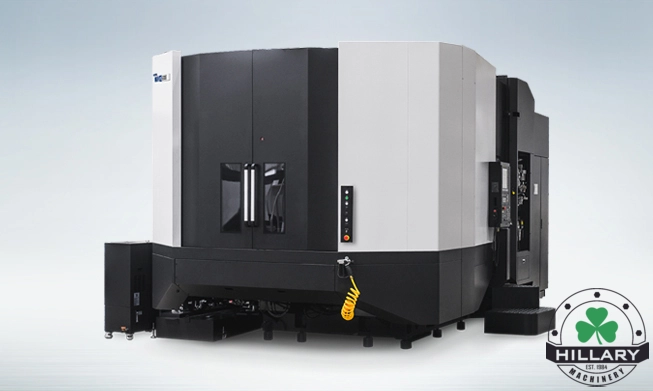
What is a horizontal machining center?
Answer: An HMC is a CNC machining center with a horizontally oriented spindle. Depending on its configuration, it mills, drills, taps and bores from several directions while the workpiece is indexed on a pallet or table. Many production models use automatic pallet changers.
When does an HMC outperform a VMC?
Answer: An HMC can be attractive when parts require work on multiple sides and the shop can reduce handling or prepare the next pallet during cutting. Chip evacuation and a productive fixture layout may help. A VMC may remain more economical for accessible, lower-volume work.
What does a pallet changer actually save?
Answer: It allows loading and setup on one pallet while machining continues on the other, reducing machine idle time if the workflow is balanced. It does not eliminate inspection, tool changes, fixture setup or operator needs. Estimate the actual time that can overlap with cutting.
Can an HMC machine four sides in one clamping?
Answer: Often, with an indexing or rotary table and suitable workholding. Tool access, clamps, part geometry and the table’s range determine which faces can be reached. Features on the bottom or hidden behind the fixture may still need another setup.
How should I size the pallet and fixture?
Answer: Include the complete part, tombstone or fixture, clamps and allowed rotation. Check pallet load, maximum part swing, spindle-to-centerline distance and tool reach at every index position. A part may fit the nominal pallet but interfere when rotated.
Is CAT40 or CAT50 better on an HMC?
Answer: Choose the interface with the cutters and materials in mind. CAT40 can suit faster, lighter work; CAT50 is often evaluated for larger tools and heavy cuts. Compare spindle torque, speed, toolholder mass and the actual machine architecture, not taper alone.
Why does chip evacuation matter?
Answer: With a horizontal spindle, chips may fall away from some cutting zones more readily than in a deep upward-facing pocket. The benefit still depends on part geometry, coolant flow, enclosure and chip conveyor. Review difficult cavities and long-running cuts specifically.
How large should the tool magazine be?
Answer: Count all cutters, duplicates, sister tools, probes and tools needed across the pallets or part family. A magazine sized only for one program may force downtime during a mixed production schedule. Check maximum tool diameter, length and weight as well as station count.
Can an HMC be automated beyond two pallets?
Answer: Some configurations support pallet pools, robots or other handling systems. The cell also needs stable fixtures, tool life, chip control, process monitoring and inspection. Ask for an automation layout based on your parts and run schedule.
How do I estimate HMC payback?
Answer: Compare the current route to a proposed HMC process at realistic annual volume. Include fixtures, programming, tooling, setup, cycle time, labor, scrap and expected spindle utilization. The most useful metric is the cost and capacity per good part, not a theoretical cutting speed.
Application review checklist
- Calculate loading, indexing and cutting time for a representative part.
- Check part swing, pallet load and fixture access at every index position.
- Account for tombstones, tool capacity, chip management and service clearance.
- Compare annual good-part output and labor, not only machine purchase price.
Explore machines and discuss your application
Hillary Machinery supports manufacturers across Texas, Oklahoma, Arkansas, Louisiana, Mississippi, Alabama and Tennessee. Specific models and availability should be confirmed for your location and application.
Email your part drawing and requirements or call 972-578-1515.