
Horizontal Boring Mills: Large-Part Buyer Questions
Compare spindle reach, table arrangement and access to deep or multi-face features
Horizontal boring mills combine large work envelopes with a horizontal spindle and, on many machines, an extendable boring spindle. Selecting one requires an operation plan for the part, not only an X/Y/Z travel comparison.
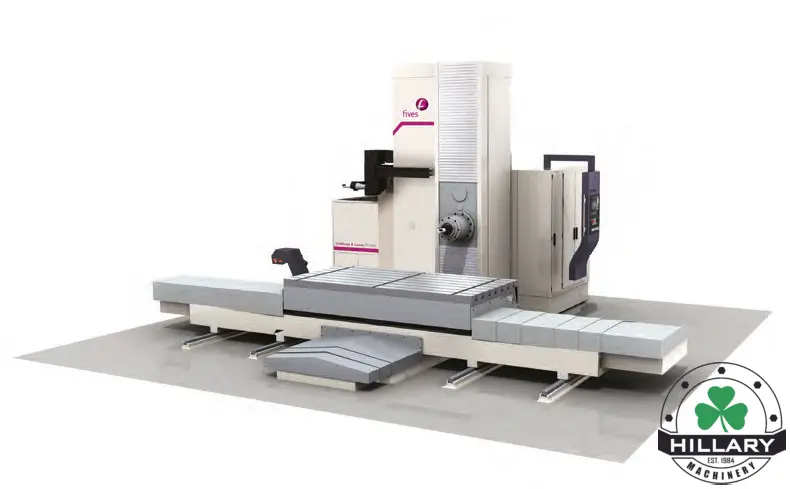
What is a horizontal boring mill?
Answer: It is a CNC machine with a horizontal spindle suited to boring, drilling, milling and tapping large or heavy workpieces. Many HBMs have an extendable spindle for reaching into deep features. Configurations vary from plain-table to rotary-table and machining-center-style designs.
What is the W-axis on an HBM?
Answer: On many horizontal boring mills, W is the programmable extension of the boring spindle or quill toward the part. It adds reach beyond the machine’s other linear travels. Check the exact axis definition and stiffness at the required extension on the proposed model.
When should I consider an HBM instead of an HMC?
Answer: Consider an HBM when the part is large or heavy and deep bore access, spindle reach or flexible setup dominates the process. An HMC may suit repeated palletized parts within its swing and load capacity. Compare the full operation plan and fixture requirements.
What is the difference between a plain and rotary table?
Answer: A plain table provides a work platform for the component and fixture; a rotary table adds programmable angular positioning for access to other faces. A rotary table can reduce reclamping on suitable parts, but its load capacity, accuracy and travel must fit the work.
How do I check bore accuracy?
Answer: Identify diameter, depth, positional relationship and finish requirements for each bore. Then evaluate spindle support, tool overhang, boring-bar stiffness, thermal conditions, workholding and inspection. A deep bore may need a different tool and cutting strategy than a shallow one.
Can an HBM mill and drill as well as bore?
Answer: Yes, many CNC boring mills support milling, drilling and tapping with appropriate tooling and machine configuration. Spindle power, tool changer, attachments and coolant options vary. Specify all intended operations rather than treating boring capacity as the complete capability.
How should I size the work envelope?
Answer: Measure the part plus fixture, not just the finished casting or fabrication. Check table or floor-plate load, tool reach, spindle-to-table geometry, X/Y/Z/W travel and safe clearances at every required face. Include the lifting and loading path.
Are angle heads or contouring heads available?
Answer: Some machine families offer right-angle heads, contouring heads or programmable boring bars to reach additional features. Availability and automatic change capability are model-specific. Verify attachment length, tool access, control support and the proposed cycle.
What site preparation may be needed?
Answer: Large HBMs can require planning for foundation, floor load, power, coolant, chip disposal, crane access and service clearance. Request installation requirements for the exact machine and assess them alongside the part-handling process.
What belongs in an HBM application review?
Answer: Send the drawing or 3D model, material, raw and finished dimensions, weight, bore specifications, tolerance stack and annual volume. Identify all faces to machine and current setup time. Ask for a workholding and tool-access concept before comparing quotes.
Application review checklist
- Mark bore locations, depths, tolerances and required face access.
- Include part, fixture and table or floor-plate loads.
- Check X/Y/Z/W motion, spindle diameter and tool reach together.
- Plan lifting, foundation, chips, coolant and inspection before ordering.
Explore machines and discuss your application
Hillary Machinery supports manufacturers across Texas, Oklahoma, Arkansas, Louisiana, Mississippi, Alabama and Tennessee. Specific models and availability should be confirmed for your location and application.
Email your part drawing and requirements or call 972-578-1515.