5-Axis Machining Centers: Questions Buyers Ask
How to decide whether 5-axis capability fits your parts and production process
A 5-axis machine adds two rotary axes to three linear axes. The right configuration depends on the actual part, fixture, cutting angles and volume. Use these questions to compare the complete process instead of choosing by axis count alone.
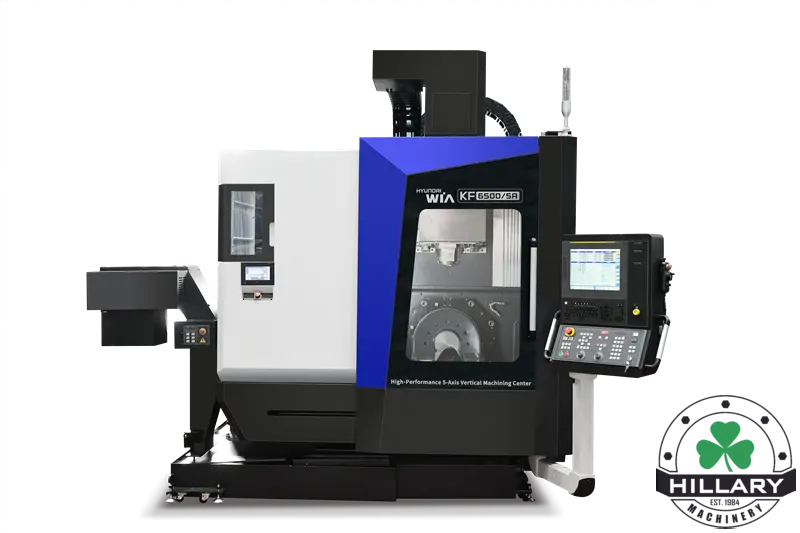
What is a 5-axis machining center?
Answer: It is a CNC machine with three linear axes and two rotary axes that orient the tool or workpiece. That extra orientation can expose several faces or angled features without reclamping the part. The machine architecture determines its usable travel, part swing and tool access.
When does 5-axis machining make sense?
Answer: Consider it when multiple fixtures, compound angles, deep angled features or contoured surfaces make the current process slow or difficult to hold consistently. Savings may come from fewer setups and better feature relationships, not simply a faster individual cutting pass.
What is the difference between 3+2 and simultaneous 5-axis?
Answer: In 3+2 machining the rotary axes index to an angle and stay fixed while the linear axes cut. In simultaneous 5-axis machining the rotary and linear axes move together during cutting. Multi-face prismatic parts may need only 3+2; complex flowing surfaces may require simultaneous motion and appropriate CAM.
Should I choose a trunnion or a swivel-head machine?
Answer: A trunnion tilts and rotates the part on a table; a swivel-head design changes the tool orientation, often with a rotary table or another axis. Compare part weight, height, swing, access and fixture design. Neither layout is universally superior for every component.
Will a part that fits the table fit at every rotary angle?
Answer: Not necessarily. The part, fixture, clamps and toolholders sweep through a larger volume as the rotary axes move. Check the complete motion envelope and interference zones at the required angles, including clearance to the spindle nose, enclosure and adjacent components.
Does 5-axis replace every 3-axis VMC?
Answer: No. A conventional VMC may provide a simpler and lower-cost process for parts machined efficiently from one direction or with a small number of setups. Compare the full route, including programming, workholding, inspection and operator time, before moving work to 5-axis.
Does spindle taper matter on a 5-axis machine?
Answer: Yes. Tool interface, spindle speed, torque, cutter diameter and tool gauge length affect the cutting process. Compare the tools and materials you actually use; CAT40, CAT50 and other interfaces have different practical tradeoffs and are not interchangeable just because a machine has five axes.
What programming and inspection changes may be needed?
Answer: More rotary motion usually adds CAM, postprocessor and collision-checking requirements. Establish a verified work offset and tool-length process, then consider probing for setup and feature checks. Simulate the actual machine, fixtures and tools before a first run when the geometry is complex.
Can a 5-axis machining center be automated?
Answer: Often, but the configuration matters. Pallets or robots must clear the enclosure and rotary envelope, and the fixture must present the part repeatably. Evaluate loading, tool life, chip management and inspection with the machine rather than assuming unattended cutting is automatic.
What information should I send for a 5-axis recommendation?
Answer: Provide a drawing or model, material, raw stock, finished dimensions, tolerances, estimated volume and current setup count. Identify the hard-to-reach features and desired finish. Hillary Machinery can then compare machine architecture, spindle, rotary clearance and workholding against the actual part.
Application review checklist
- Send a representative part drawing, material, annual volume and current process route.
- Include the fixture, toolholders and required tool approach angles in the envelope check.
- State whether 3+2 positioning or continuous simultaneous motion is required.
- Compare setup hours, scrap risk and total cycle time before estimating payback.
Explore machines and discuss your application
Browse CNC machining centers, 5-axis machining centers, vertical machining centers. Hillary Machinery supports manufacturers across Texas, Oklahoma, Arkansas, Louisiana, Mississippi, Alabama and Tennessee. Specific models and availability should be confirmed for your location and application.
Email your part drawing and requirements or call 972-578-1515.